
I. INTRODUCTION
The era of Industry 4.0 and Society 5.0 are reshaping the way organizations function and interact with the communities they serve (1) and digital transformation has been in the spotlight in recent decades, especially in the daily lives of businesses. According to the authors (1) , the evolution towards the concept of digital transformation has been somewhat slow as far as universities are concerned. However, with the advent of the COVID-19 pandemic, digital transformation has proven to be very necessary for universities with regard to virtualizing and digitizing core processes, including student relations and the delivery of classes, even for face-to-face courses.
Administrative and academic processes are the basis for generating services to the university community, so the need arises to change the procedures and work culture of the institution and integrate digital technology, which supposes a Digital Transformation process (2). Digital transformation involves changes in structure, strategy and technology to help meet the needs imposed by a digital environment (3) and is therefore intrinsically related to a review and improvement of processes.
To achieve a consistent digital transformation, it should be supported by process improvement that is worked on in a holistic and organic way, considering and involving different actors within the University. It is necessary to consider context and history, but also to maintain alignment towards strategy. A consistent process discussion will therefore take into consideration people and their stories, strategy, and the necessary, possible, or appropriate technology.
The diversity of levels and profiles of people participating in process improvement is fundamental to generate new knowledge. This approach, although complex, is powerful in identifying important knowledge that can be used and shared across the University. The strategy will guide the direction in each group or community of practice where discussions will be held. It will also guide the definition of what and how to measure in order to understand the direct contribution of process improvement to the institutional goal.
As a matter of fact, knowledge is part of any and all process discussions. It will function as the basis for the knowledge and understanding of the process as such, but also as the driving element for its improvement. This happens when the people involved have different spaces and visions that complement each other in the formulation of new knowledge.
Normally companies apply process improvement methodologies disregarding the real participation of people. They disregard their baggage and experience in performing processes or activities. This tacit knowledge space is of capital importance in the knowledge generation process. Only the already formalized knowledge, materialized in documents or internal rules, is taken into account in process improvement, but they don’t tell the whole story.
Process improvement deals with activities performed daily by people in any and all companies. It is a review and adjustment of the work and results, oriented from the strategy and the purposes it wants to achieve.
When carrying out the interpretative case study at the Universidad Técnica Particular de Loja – UTPL on process improvement for digital transformation, the researchers identified several actions applied based on the concepts of knowledge management, such as the realization of communities of practice. The methodological steps taken are presented, which help to understand which collaborative processes for the development of knowledge have better results both in the generation of ideas and in the implementation and maintenance of the processes in question.
The studies show that process improvement as such is a complex and knowledge intensive process, even more so when it comes to a digital transformation project.
The main objective of this study was to understand if the knowledge management practices, such as the Community of Practice, applied in the case study, would allow an effective improvement of the processes, which can be positively corroborated in the results presented in the discussion and conclusions sections.
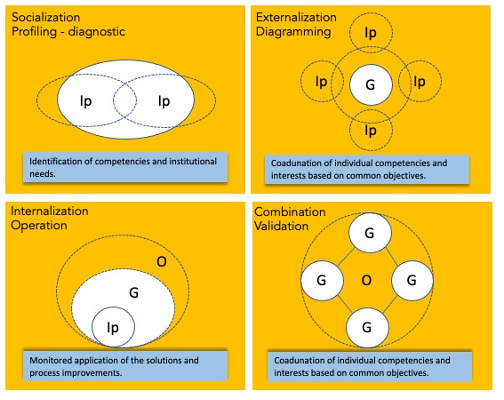
The monitoring of the activities performed by the groups (community of practice) has allowed us to understand that the stages of knowledge generation through socialization, externalization, combination, and internalization consistently improve the processes.
Through the interpretative case study methodology, it is possible to understand the relevance of considering knowledge management actions to improve processes. The construction of this knowledge occurred in the application of the methodology, in the interaction with people and in the participation of the group discussions, and in the evaluation of the results about the processes.
II. Theoretical Review
A. Communities of Practice applied to Business Processes Improvement
Business process is a set of activities that define how to achieve organizational goals and also produces outputs that deliver value to customers and business process improvement is very important to make the organization better, more competitive and successful (4) (5).
According to (6), given that each business situation and each business process have unique characteristics, it is difficult to develop and adapt a common universal methodology that is applicable to all types of business situations and contexts and delivers the outcomes in all types of business scenarios and contexts. The authors suggest that instead of deploying a methodology for achieving process improvements, organizations have been forced to discover the “best practice business processes” and adopt them to their local business situations.
Business leaders are currently taking a new holistic approach to business processes management that incorporates people, processes, systems, and strategy (7). knowledge is considered an integral part of the business process and not something to be managed separately. It is deeply embedded not only in documents, models, or formal repositories but also in organizational routines, processes and practices (8).
Approaches based on knowledge management can offer alternatives for best practices applied to business process improvement. As research around knowledge management confirms that people develop new practices even when engaged in highly repetitive, routine business processes (6), Knowledge and especially process knowledge, is inseparable from individuals and their actions (9).
Communities of practice are applied for purposes such as problem solving, information management for larger purposes, and decision making to create space for dialog and thus enable knowledge sharing (10).
In this sense, Communities of Practice seem to be perfectly applicable to this context, whereas it can be considered as a best practice towards business process improvement. It is a combination of experience, context, interpretation and reflection, and involves more human participation than information (11).
The theory of Communities of Practice was developed by (12) from the frameworks of situated cognition (13) and cognitive apprenticeship (14), which were alternatives to traditional information processing models of cognition that often-neglected social variables. (15) later defined COPs as ‘‘groups of people informally bound together by shared expertise and passion for a joint enterprise’’ (p. 139).
Reference (16), affirm that communities of practice are not only a tool that helps to transfer implicit knowledge but also to trigger innovation, essential for business process improvement. According to the authors, for an effective Community of Practice, the task of the organization’s knowledge management is to ensure adequate surrounding conditions for this to happen, such as clear communication of the rules for external knowledge exchange, the commitment of the top management for intra-organizational knowledge exchange and a mixture of information and communication tools.
III. METHODOLOGY
In order to document the implementation of knowledge management elements, such as communities of practice, applied to process improvement at Universidad Técnica Particular de Loja – UTPL in the context of digital transformation and identify what are the results of this working model, an interpretative case study was conducted.
The main research question that this study investigates is:
RQ1. What is the influence of group discussions (communities of practice) on knowledge generation and consequent process improvement?
To achieve a possible answer to this question, the interpretative case study was determined as a method to account for the complexity of the development of activities related to process improvement with the application of collaborative discussion through a model similar to that of communities of practice (17).
Interpretive studies are characterized by the search for an understanding underlying the facts presented. They hope to reveal the complexity of particular or collective social relationships that are not usually highlighted in quantitative studies (17). This type of method helps to understand how phenomena occur from a deep interpretation, supported by the experience that participating people give to them (18).
In order to fully understand the dynamics developed with the working groups and the relevance of the discussions held for process improvement, semi-structured interviews were conducted with the personnel participating in the project, and document collection and analysis were carried out.
The researchers also had the opportunity to participate in different moments of the process discussions in the working groups as observers, following the development of the methodology and the maturing of the discussions around the processes.
In the practical development of the research activities, in addition to the researchers, around 500 people were involved, a group more directly involved and another group with sporadic participation or in validation activities.
The working groups or teams were distributed as follows:
CRM: 15 staff involved, 12 processes;
Register of persons: 50 staff involved, 6 processes;
Admission and enrollment: 15 staff involved, 14 processes;
Faculty Administration: 15 staff involved, 17 processes;
Curriculum: 47 staff involved, 19 processes;
Student Administration: 51 staff involved, 11 processes;
Student Financial: 23 staff involved, 30 processes;
Technical (migration, integration, cloud): 31 staff involved.
The formation and performance of the groups based on the community of practice model is the central point in the development of this research. To understand how the space for dialogue created in the implementation project of the technological solutions helped or not in the generation of knowledge and the consequent improvement of processes.
IV. ANALYSIS, FINDINGS AND DISCUSSION
This section presents the analysis and the main results found during the research. It focuses on the identification of elements of knowledge management used during the process improvement, especially in the adoption of the strategy of communities of practice.
The process improvement oriented to digital transformation covers about 100 processes supporting academic and university management, identified in the value chain structure as core processes. Processes from the definition of courses and graduate programs to processes of attention and relationship with students and community are considered. From this scope, it is intended to identify the strategies, actions and practices related to the generation of knowledge in the development of the discussions of the groups formed for process improvement.
In general, the initial stages of the process methodology consider only the vision of the person responsible for the process or the people who participate directly in it. Therefore, explicit knowledge is considered, which is formalized in the organization and serves to transmit a certain level of knowledge to other people. However, this dynamic is not able to consider intangible elements of knowledge, which are lost during the formalization or registration of the process in its ‘current’ situation. Part of the history of the process is not recognized, because there is no adequate space for people with the experience of the process to externalize such knowledge.
Also, in the traditional dynamics there is no time for dialogue or contemplation of the results of the process from perspectives other than that of the owner or the executors of the process. Process improvement is seen, therefore, as a restrictive and technicist activity, not considering history and often not even the culture in which it is completely submerged.
At UTPL the structuring of the digital transformation project was done starting with the constitution of working groups. People with knowledge, experience, and a vision of the need for improvement were identified, as well as people with distinct profiles and perspectives within the University. The groups were organized considering the complementarity of knowledge for process improvement.
From the identification of the processes that would be worked on with the integrated management system for academic administration, the groups were determined, always composed of teachers’ profiles, directors’ profiles, administrative profiles, and technical profiles. Each group had a delimited scope about which it defined a vision for improvement, validated among peers and then with the relevant authorities.
Every project was worked out based on a timeline for implementing the technological solutions and, therefore, the groups would have to follow the pre-determined steps.
In the initial stages, discussions were held at conceptual and higher abstraction levels, where the groups learned about the tools, what best practices they brought and how they could be applied or shaped according to the University’s needs or competitive differentials. In these phases, the general models were created for each process group aligned to the improvement vision.
In the final phases of the project, the groups worked with the unfolding of the general model into processes or system configuration definitions, which were then tested and adapted according to the needs.
Once these process models were created and validated in the use of the technological tools, the groups expanded the discussions in two directions: in the first direction, continuing with the validations with the academic and administrative authorities. This constant dialog was necessary to maintain alignment with the initial vision of each process package. The objective was to overcome the limitations previously pointed out, specifically about the complexity of the University and the number of people involved in each process. In another sense, the groups validated the proposals for improvement and new processes with the areas that would be responsible for these processes in the future.
The latter was a very delicate point, because different intentions or aspirations about a certain set of processes were at stake. The dialogue and the communication and sensitization actions were fundamental to appease and align expectations, although at certain moments it was not possible to reach a common negotiation point.
Throughout the project, dialogues were held at different levels: internally within a group, between groups, between the groups and the academic and administrative authorities,
involving the different players in the processes, the student care people, the coordinators of courses and graduate programs, continuing education, and others.
The figure below represents the structure of dialogues held between the different authors during the project.
Maintaining dialogue and levels of review, validation, and approval worked to provide assurance and security for the teams. By having intentional spaces for discussion, the knowledge creation process worked in an appropriate and timely manner.
The working model adopted with the groups was based on models of communities of practice and used basic processes of knowledge creation as a foundation.
The results can be seen in at least three dimensions.
The first one is the implementation of the technological solution within the time, cost, and quality determined in its objectives. The possibility of dialog among the groups and the involvement of different profiles contributed to the adequate involvement in the fulfillment of each activity for the implementation.
The second dimension is in the broad discussion held about each process, with the opportunity for institutional review of policies, internal regulations, and evaluation of the impacts that each change or process improvement would represent. The formalization and generation of institutional documents will also act in the next cycle of knowledge generation.
The third dimension is related to institutional results. Among its strategic objectives, objective 3.4 determines: Implement an institutional intelligence model for strategic decision making, resource optimization, and knowledge management for institutional sustainment. By delivering the implementation of a technological tool oriented towards process improvement that was carried out based on a broad and collegiate institutional discussion, not only processes but a viable model of knowledge management has been delivered.
There was an increase in satisfaction in the consumption and use of institutional information and processes identified from the students. Internal clients also perceive positive impacts in the management of information needed for decision-making.
V. CONCLUSIONS
This research carried out an interpretative case study, the researchers sought to understand how the applicability and impacts of elements of knowledge management, such as Communities of Practice in the discussion of process improvement necessary for the digital transformation project that the Universidad Técnica Particular y Loja has gone through and is still going through. The results corroborate that every space where there is the opportunity for dialogue and collective construction is, in some way, knowledge management activity [6]. There is fundamental importance in the intentionality and direction of these activities and spaces. The top management of the University had a fundamental participation in validating the visions of the process packages or modules, to the institutional strategies, actively participating in the dialogue spaces.
No specific methodology for process improvement was applied, and it is identified that the sophistication of the implemented actions lies in their simplicity, the creation of dialogic spaces involving different levels and profiles. The shared understanding was reached precisely by the open discussion about the possibilities of using the technological tool and the consideration of the impacts that the changes could provoke in the University.
Knowledge creation as a process starts with the possibility of socialization and externalization of implicit knowledge. And the discussion around real problems and practical cases advances in this direction.
Working with different profiles broadened the perspective of each profile, adding elements that were previously unaware. The focus was not exactly on the modus operandi, if not on the knowledge that each participant had about the topic under discussion. This created insight into each set of processes. Only then can each process be determined. For example, when discussing the way curricula would be registered in the system to be then operated in processes such as matriculation or recognition of studies, the directors of undergraduate and graduate courses were called in to discuss what types or models of courses they would be designing for the next generations. From a knowledge management perspective, the collaborative discussion in the communities of practice or the groups, served to create a shared understanding, a shared vision of how curricula will be designed in the coming years.
In each set of processes, the collaborative discussion contributed to building new perspectives for the knowledge intensive processes of the University. Even though in some cases the new vision is very similar to the current vision, the timeliness of the discussion helped bring knowledge ingrained in individuals to a level of institutionality.
With the involvement of a large number of people from the University, although some actors in lesser intensity, it was sought from the beginning of the discussions to make the changes and the themes familiar to people.
The main conclusion of this research is that digital transformation can happen effectively as long as there is a discussion about institutional processes and that this discussion, in turn, is carried out with basic elements of knowledge management, such as, in this case, the implementation of communities of practice. Process improvement is, in itself, a knowledge management action. The way the discussions for this improvement are carried out may amplify the results, which we tried to demonstrate in this study.
When a participative and complete discussion about the processes is made possible, this will certainly lead to a consistent and continuous improvement, impacting on the institutional results. Thus, besides the process improvement model adopted, the effort was on identifying the results and impacts that these improvements would bring to the University.
What organizations do every day must be completely oriented by their strategy and seeking to achieve determined results. One of the ways to accomplish this alignment is through the creation of intentional and systematized spaces for dialogue, giving the opportunity for each individual’s implicit knowledge to contribute to the formation of new knowledge.
The complexity of the institution and the macro project of digital transformation, which often implies ambiguity of interests and difficulties in decision making, can be pointed out as limitations to the study. Another limiting factor to be considered is the number of people involved in the project: directly, about 100 people, and indirectly, about 400 people.
This means that in order to obtain process improvements aimed at digital transformation, it was necessary to count on the mobilization of people around a result, often not specific, but which guided the development of the work in the groups.
It is not possible that the limitations described above have affected the validity and reliability of the study, because the objective was not to generalize, but to identify the importance of group discussions or communities of practice for process improvement.
REFERENCES
[1] Rodríguez-Abitia, G. and Bribiesca-Correa, G. (2021). “Assessing digital transformation in Universities”. Future Internet, 13, 52. https://doi.org/10.3390/fi13020052
[2] Coral, M. A. and Bernury, A. E. (2022). Challenges in the digital transformation process in higher education institutions an universities. International Journal of Information Technologies and Systems Approach (IJITSA). DOI: 10.4018/IJITSA.290002.
[3] Drechsler, K., Gregory, R. W., Wagner, H. t. and Tumbas, S. (2020). At the crossroads between digital innovation and digital transformation.
Communications of the Association form information System. DOI. 10.17705/1CAIS.044.
[4] Pratama, A. A., Sensuse, D. I. and Noprisson, H. (2017). “A systematic literature review of business process improvement. In: 2017 International Conference on Information Technology Systems and Innovation (ICITSI). IEEE, 2017. p. 26-31.
[5] Pereira, R. Silva, B. A. and Varvakis, G. (2021). Inovação na gestão de processos: uma revisão integrativa. SINGEP 2021 – IX SINGEP and 9th CIK Online Conference. São Paulo, Brasil.
[6] Seethamraju, R. and Marjanovic, O. (2009). “Role of process knowledge in business process improvement methodology: a case study”. Business Process Management Journal. 10.1108/14637150911003784.
[7] Gartner Research (2006), “Gartner position on business process management”, Gartner Research Note.
[8] Amarvadi, C.S. and Lee, L. (2005), “The dimensions of process knowledge”, Knowledge and Process Management, Vol. 12 No. 1, pp. 65-76.
[9] Davenport, T.H. and Short, J.E. (1990), “The new industrial engineering: information technology and business process redesign”, Sloan Management Review, Summer, pp. 11-27.
[10] Davenport, T.H (2005), Thinking for a Living: How to Get Better Performance and Results from Knowledge Workers, Harvard Business School Press, Boston, MA.
[11] Ulbricht, V. R. and Vanzin, T. (2013). Comunidades de prática em ambientes virtuais de ensino e aprendizagem acessíveis. (In) Mídia e educação: novos olhares para aprendizagem sem fronteiras. Busarello, R. I. Bieging, P. and Ulbricht, V. R. (org).
[12] Lave, J., & Wenger, E. (1991). Situated learning: Legitimate peripheral participation. Cambridge, UK: Cambridge University Press.
[13] Brown, J. S., Collins, A. & Duguid, P. (1989) Situated cognition and the culture of learning,Educational Researcher, 18, 3242.
[14] Collins, A., Brown, J. S., & Newman, S. E. (1989). Cognitive apprenticeship: Teaching the crafts of reading, writing, and mathematics. In L. B. Resnick (Ed.), Knowing, learning, and instruction: Essays in honour of Robert Glasser, (pp. 453-494). Hillsdale, NJ: Lawrence Erlbaum Associates.
[15] Wenger, E. C., and Snyder, W. M. (2000, January–February). “Communities of practice: The organizational frontier”. Harvard Business Review, 139-145.
[16] Weissenberg, M. A. and Ebert, D. S. (2010). “Organisation’s knowledge together–communities of practice as facilitator for innovations inside an affiliated group”. In: Innovation through Knowledge Transfer 2010. Springer, Berlin, Heidelberg, 2011. p. 245-252.
[17] Yin, R. (2003), Case Study Research: Design and Methods, 3rd ed., Sage, Thousand Oaks, CA.
[18] Deetz, S. (1996), “Describing differences in approaches to organization science: rethinking Burrel and Morgan and their legacy”, Organization Science, Vol. 7, pp. 191-207.
[19] Takeuchi, H., Nonaka, I. (2009). Gestão do Conhecimento. Bookman.
